To produce one token, roughly one word, a language model builds more than a hundred hidden vectors. About a million numbers, describing everything it currently holds about the problem in front of it. Around two megabytes of internal state. Then it picks one entry out of a vocabulary of around 150,000 and throws the rest away.
Seventeen bits leave the model. The two megabytes are never used again.
Every system that connects models together runs on those seventeen bits. Coding subagents, model councils, routing providers: text is the only channel any of them has. Systems built to think in thousands of dimensions are effectively talking to each other through a keyhole.
Today we are coming out of stealth to say what we have been doing about that.

What gets discarded is not spare capacity
The assumption is that the hidden state is scaffolding, and that the token is the finished product. Interpretability research from the past two years says otherwise.
Transformers plan ahead. Consider how a model chooses between "a" and "an." To get the article right it has to already know the noun, and it does: Hanna and Ameisen (ICLR 2026, arXiv:2604.12493) show that Qwen-3 carries a representation of "accountant" several tokens before writing it, and that this representation is what produces the "an." They also find the effect grows with model size, so larger models hold more that the text never shows.
Anthropic's interpretability team found the same mechanism running over a full line of verse in Claude 3.5 Haiku: the model settles on its rhyme before writing toward it (Lindsey et al., 2025).
A second result from the same group goes further. Their Jacobian lens identifies the concepts a model is poised to say at any moment, a set they call J-space: a small, shifting collection of unspoken words naming what the model is working with right now, neither an echo of the input nor a guess at the next token. A model can be asked to hold a concept there and will silently keep it while its visible output carries on unchanged. Their own summary is that these measurements uncover internal reasoning and reactions that never appear in the output (Gurnee et al., 2026).
So when one model writes a sentence for another model to read, what is lost is not formatting. It is the deep computation–the considerations behind the choice.
Why this matters
So far, AI has scaled along two axes.
Pre-training, scaling data and parameters brought world knowledge. Scaling test-time compute through single-agent reinforcement learning brought reasoning and planning. Both have been flattening for a while.
The next axis for scaling is models coordinating with each other, and it has to be reached through multi-agent RL, which is a qualitatively harder problem than single-agent training. Efficient coordination requires efficient communication. Right now models coordinate by writing sentences to each other, losing almost everything they computed to produce those sentences.
That is the axis we are working on, and communication is the part of it we started with.
What we built
One model hands its hidden states to another through a small trained bridge, and the receiving model works with them directly. No output-type text passes between them, and neither model's weights are touched. The bridge is the only new part of the system.
It is also the company's name: Mostik means “little bridge”.

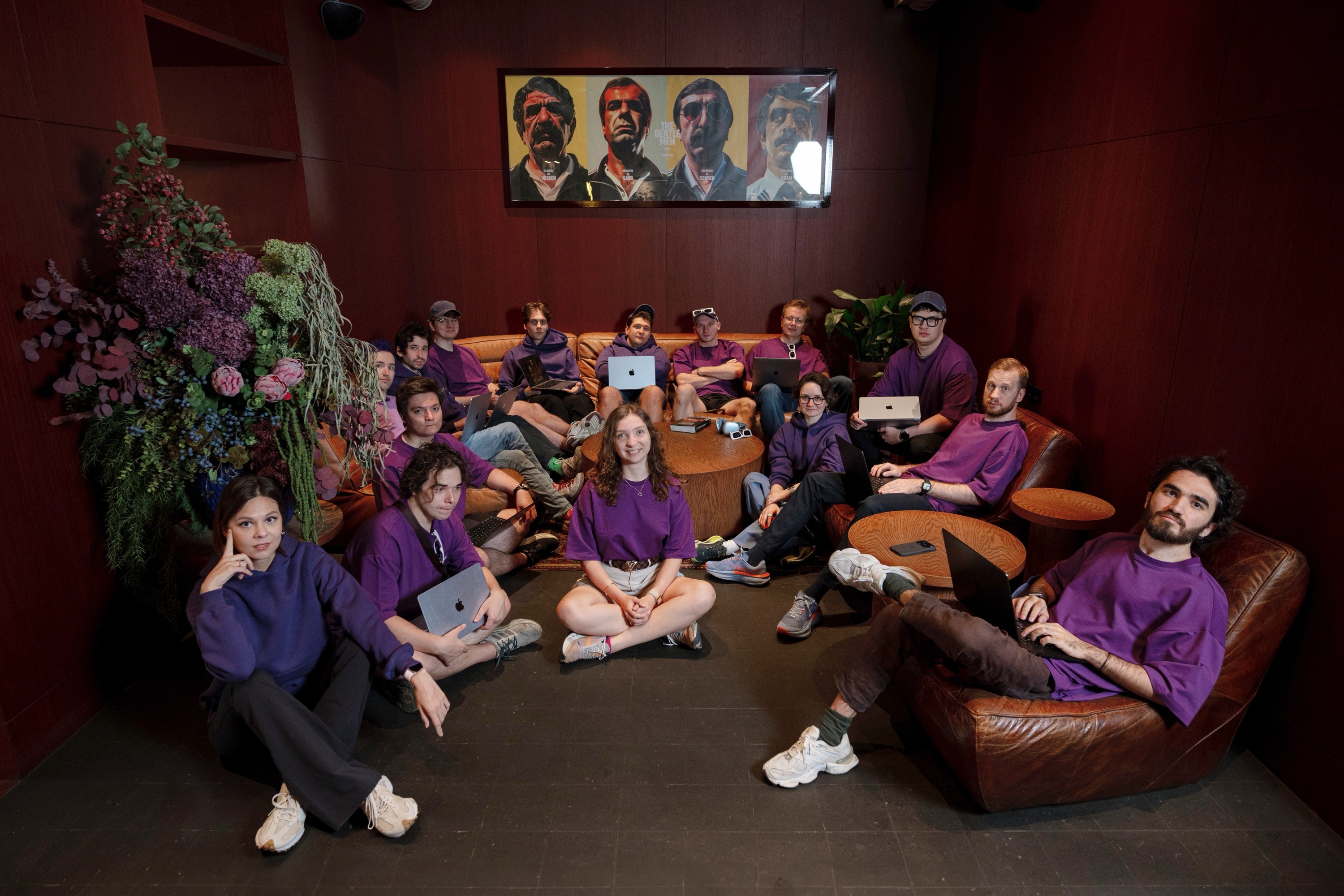
There are 15 of us: 12 PhDs and a Fields Medalist.
We started four months ago.
We started with the geometry
How easily two models can be bridged is a question about the geometry of the spaces they compute in. So that is where we began: what those spaces look like, and how much structure any two models already share.
Both answers turned out to matter.
Alignment between models does not increase on its own as models get more capable, so a bridge has to be built rather than expected to emerge. Some alignment is there, however, and it varies in ways we can predict. The question is never whether a translation exists between two models, but rather how much work it takes to find.
The first result
The first thing we built is a bridge from a large model to a small one. We chose that pairing because deployments already want it: a large model that knows things, and a cheap model that does the writing. Our sender and receiver are GLM-5.2 (753B) and Qwen-3.5 (4B), a leading open-source model and a popular edge-device-class one.
The economics come from an asymmetry in how models run. Writing an answer happens one token at a time and costs a lot. Reading a prompt is one parallel pass and costs significantly less.
So, in these experiments the large model never writes. It reads the problem, its hidden states cross the bridge, and it stops. The small model does all the generation.

On its own, the small model scores well below the large one, and the distance between those two scores is the gap to close. With the bridge attached, the small model closes 50% of that distance, which lifts its own accuracy by 25%. On harder subsets, where the gap between sender and receiver is more pronounced, that uplift reaches 2x.

The same result reads a second way. Somewhere between our small model and our large one sits a mid-sized model that would score exactly what the bridged pair scores–and you could deploy that instead. Running the bridged pair costs 2.5x less compute than running such a model.
We also compared the setup against other standard ways of combining one or several models. Across those setups, the bridged system shows a clear Pareto improvement.

We compared our method, which allows models to communicate by sharing their internal states, with existing approaches for handing work from one model to another. In each case, the larger model worked through part of the problem before passing what it had produced to a smaller model. In the case of the traditional text hand-off, it passed the text it had written so far; with our latent hand-off, it passed the internal state it had built up while reasoning about the problem.
The latent hand-off performed better at every level of large-model compute we tested, improving performance by as much as 10 percentage points. The advantage was greatest when the hand-off happened very early, before the larger model had written anything. At that point, a text-based approach has nothing to pass along, while the latent state already contains information the model has developed from reading and processing the problem. As more compute is given to the larger model, the two approaches eventually converge toward large-model performance, but the latent approach provides a better performance–compute trade-off throughout.
Both models stay frozen
Our approach doesn’t alter either model. Both remain completely frozen; the bridge is trained separately and is the only part of the system that learns anything.
That matters for two reasons.
First, it tells us something about model representations. Two models built by different teams and trained on different data develop internal representations similar enough that we were able to translate between them without fine-tuning either model. We froze both models deliberately to make this a strict test: if useful information can pass between them without either model being adapted to the channel, then the bridge is exploiting a structure that was already present.
Second, it makes the approach practical to deploy. Many systems already use a powerful model as an advisor to a smaller, cheaper model. At key decision points, the advisor reads the conversation and writes out guidance for the smaller model. That requires paying for the expensive model to process the full context and then paying again for it to turn what it knows into words. Our approach removes the second payment. The advisor reads the full context as it always has, then stops. Its guidance crosses as latent state instead of tokens.
A potential tool for observability
The bridges mostik.ai makes may have another use: helping us see what models are doing.
Chain-of-thought monitoring sees only the reasoning a model puts into words. It remains one of the field’s best tools, but it is imperfect and fragile. Korbak et al. (2025, arXiv:2507.11473) note that some misbehaviour passes through it undetected.
A latent hand-off creates a completely different, new place to look. It gives us three related objects: the sender’s hidden state, its translated form, and the receiver’s behaviour. We can record each during a run, test what information survives the translation, and intervene on the transferred state to see what actually changes downstream.
The intervention is the important part. A decoder can produce a plausible description without identifying what caused a behaviour, but if changing a feature in the channel predictably changes what the receiver does, we have evidence that the feature was not merely present: it was being used.
We have not conclusively shown that a bridge is an observability tool, but a working map between two representation spaces creates a surface on which it becomes possible. Mostik could plausibly complement chain-of-thought monitoring, not by reading a model’s thoughts directly, but by making part of the computation between models available to measurement and intervention.
Where this goes
The bridge is trained, which means gradients run through it, so it does not have to arrive after both models are finished. It can be present while one of them is still being trained. That is what we are working on now, using distillation and specialisation..
Distillation. A teacher's supervision normally arrives at the student's output layer: at best the student sees what the teacher was about to say at each position, not the computation behind it. A channel moves that supervision inside the generation, so the teacher guides the student while the answer is being produced rather than grading it once it exists. Early signals suggest a student trained that way stays closer to its teacher for the same budget.
Specialisation. Small models appear to pick up narrow skills more efficiently when they train with the channel open, and to keep the general ability they came in with. That points at a way of extending a large model by attaching new modules onto it instead of retraining the whole thing.
Both are early and in progress.
Lastly, nothing in the mechanism is particular to a pair, and the same channel that lets one model supervise another lets several train together, combining what each of them knows into a single interwoven system.
Connecting finished models is worth doing on its own, and it is what our results show works. A channel that is present during training means models can be built to work together from inception, which is a different and much larger question than whether two of them can be joined afterwards.
Working with us
© mostik.ai