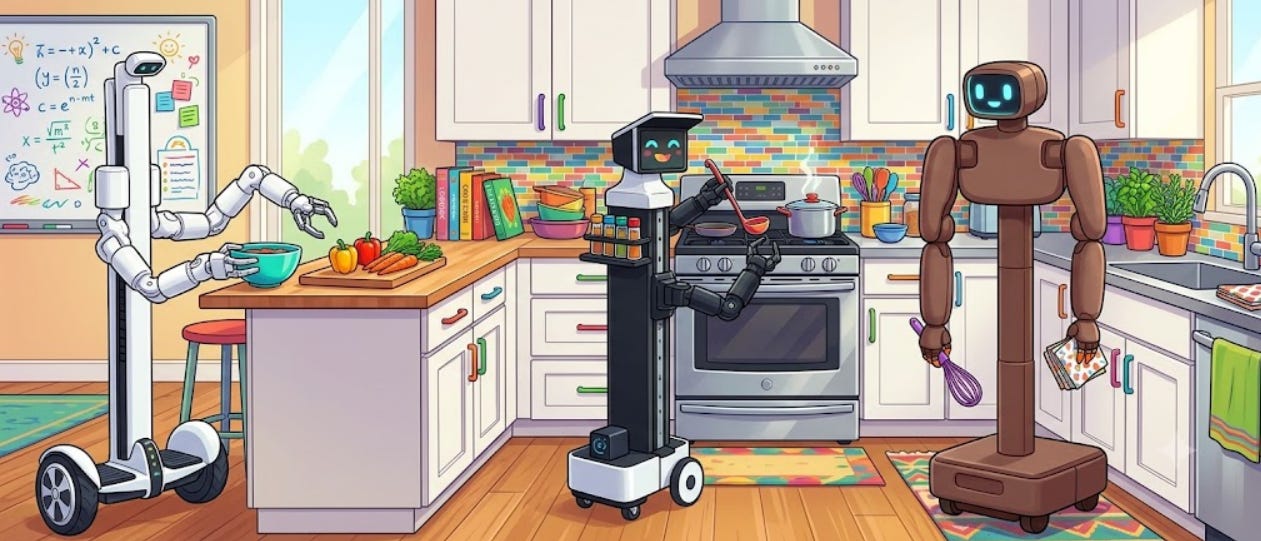
A couple startups have announced really exciting general-purpose robots in the sub-$10,000 range. These are finally, finally starting to look like something that could be made very capable.
This is exciting because it means affordable home robots, easily in the same range as common home appliances like a refrigerator or a dishwasher, are clearly only a few years from the market.
Let’s go over a couple of the latest announcements.
Size: 100cm or 130cm tall for Grande (3-4 feet)
Price: $1,288 or $1,322 for the Grande model
Compute onboard: no (thin client)
Nori Robotics, founded by Antonio Li, is selling possibly the cheapest reasonably large bimanual robot I have ever seen. It’s tall enough to reach the top of a table or countertop (though definitely not a top shelf).
The arms look similar to the SO-100, a very common low-cost open-source arm by HuggingFace; probably nice if you want to build a leader setup for teleoperation for a few hundred extra dollars. The robot itself also has a nice screen useful for telepresence.
You can read about an earlier version of in the Nori robot paper, which probably owes some inspiration to the XLeRobot which I have covered before.
You can see the announcement video here.
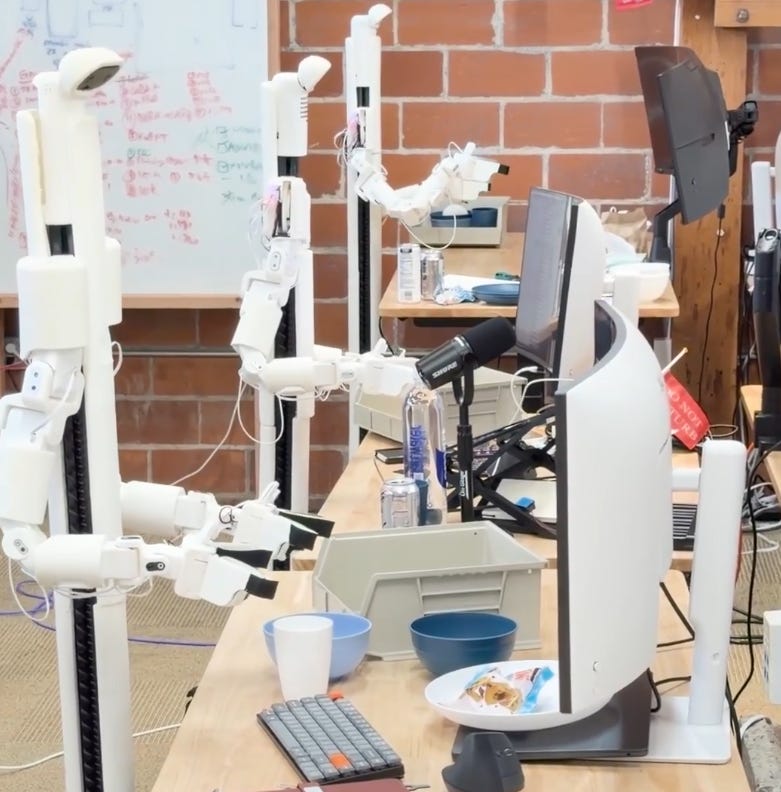
Size: ~5’ 8”
Price: < $3000
Compute onboard: possibly a Jetson Nano
Another wheeled robot manipulator, this one with a distinctive tall, thin shape, and hoverboard-style drive wheels (with stabilizers running out in front). The creators want to ship “a billion robots” and with a price like this it seems totally reasonable.
There’s a blog post on a similar project here, written by Clayton Haight. Bracketbot, though, is founded by Brian Machado.
Size: probably roughly ~5’ 6”
Price: $8,000 or $450/month
Compute onboard: unknown; teleop-enabled
The successor to Isaac 0, the clothes-folding home robot, Isaac 1 is a fully capable home mobile manipulator which can put away laundry and tidy a room. This is the first robot promising the full (semi-) autonomous experience that you can pre-order this year, after last year’s launch of the 1X NEO for pre-orders.
This probably has the most robust and full-featured software stack; you can already see Isaac 0 robots in different locations, folding clothes. According to Weave, the older model folds 1000+ pounds of clothes every week.
Another note: unlike the other two, this one clearly comes with a charging dock, which is a great and really underrated feature for a robot like this.
You can pre-order Isaac 1 here.
These robots have a couple similarities that are letting them run at low cost.
Wheels over legs. Wheels break less and require less parts. The tradeoffs in terms of going up and down stairs will most likely be worth it in terms of product lifespan without spending much more on software, sensors, compute, and model training.
Remote inference. None of them seem likely to have much compute for models; they’re largely going to rely on the cloud for this, or some other local offboard compute. Isaac 1 may be the exception, but it does allow for teleop.
End effector cameras, but simple grippers. No fancy tactile sensors or dexterous hands - just robust hardware.
Minimal actuation. The heads for BracketBot and Nori seem likely to be completely fixed.
This means they share a common set of limitations - no stairs, cannot access top shelves in a kitchen. Given the added complexity of legs, though, and the safety risks of a robot autonomously going up and down stairs, it’s not clear this is such a bad thing.
All in all — an exciting set of announcements and I would love to try out all three.